To Rename or Not to Rename
Back in November of 2023, the American Ornithological Society announced that it would be changing the English names of birds named after people.
Since then we have heard precious little, and well-known ornithologists like N. G. Howell, co-author of Gulls of the Americas, have publicly called for the scaling back of this initiative.
Given this pushback, and the current political climate in the United States, there are genuine concerns that the AOS has stalled this project indefinitely.
For me personally, changing bird names to reflect morphology, plumage, habitat or geographic distribution would be a welcome change*. Having only started birding post-pandemic, I am not as closely attached to bird names as someone more experienced.
As of this writing, the gull subfamily has 11 species named after people. Out of personal preference, I am more inclined to side with Peter Adriaens et al. (2022) on the species status of Thayer’s Gull, and unanswered questions surrounding the breeding range of this subspecies may result in further taxonomic reshuffling, but I digress.
11 species of gulls is significantly less than the ~263 total bird species that were slated to be renamed in the Americas, making them ideal candidates for imagining what new bird names could look like.
For each eponymously-named gull I have written down one or more alternative names, some of which I found in the literature or on Avibase.
This exercise helped me to appreciate different aspects of each gull’s life history, and is something I encourage other people to do for their favourite birds.
The beauty of this practice is that you do not have to make each name conform to established norms. Perhaps an Anna’s Hummingbird becomes a Magenta-headed Feeder-gem, or Barrow’s Goldeneye becomes Crescent-cheeked Whistling-seaduck.
The world of bird names is your oystercatcher (sorry).
Ross’s Gull
1. Rosy Gull
Adult birds develop a pink hue throughout their plumage, which comes from carotenoid pigments found in their diet–the compounds that make salmon and tomatoes red. Although other gulls like Franklin’s Gull can develop a pinkish hue, no other species is as constantly suffused with pink throughout adulthood.
2. Magnificent/Gorgeous/Beautiful Gull
I mean, this gull is stunning–none of the above superlatives would do it justice. To quote Ayyash, Ross’s Gull is “a wonder among wonders” (2024).
Sabine’s Gull
1. Fancy Gull
Sabine’s Gull is monotypic, the only member of the genus Xema. Xema was once described as “a fancy name, apparently devoid of meaning” (Day et al. 2020). The Sabine’s Gull’s tricoloured wing and yellow-tipped black bill are quite distinctive amongst gull kind. To rename Xema sabini Fancy Gull would make it stand out against all other bird names, fitting for a species whose genus name has no equivalent in the Greek or Latin languages.
2. Fork-tailed Gull (Avibase)
Although adults have a forked tail, there is already a Swallow-tailed Gull.
3. Xema Gull
Why not?
Bonaparte’s Gull
1. Boreal Gull
Reflective of its breeding distribution in North America. A bonus is not having to change the Alpha Code BOGU.
2. American Black-Headed Gull
I will admit it is a bit of a mouthful, but it gets the job done.
Franklin’s Gull
1. Prairie Gull
Mainly breeds in the prairies of the northern United States and Canada. Colloquially known as “prairie dove.”
2. Migratory Gull
Has one of the longest migrations of any gull, wintering as far south as Chile.
3. Grey-tailed Gull
Adult gulls often have grey on the central rectrices. A name reflecting this overlooked feature would be interesting.
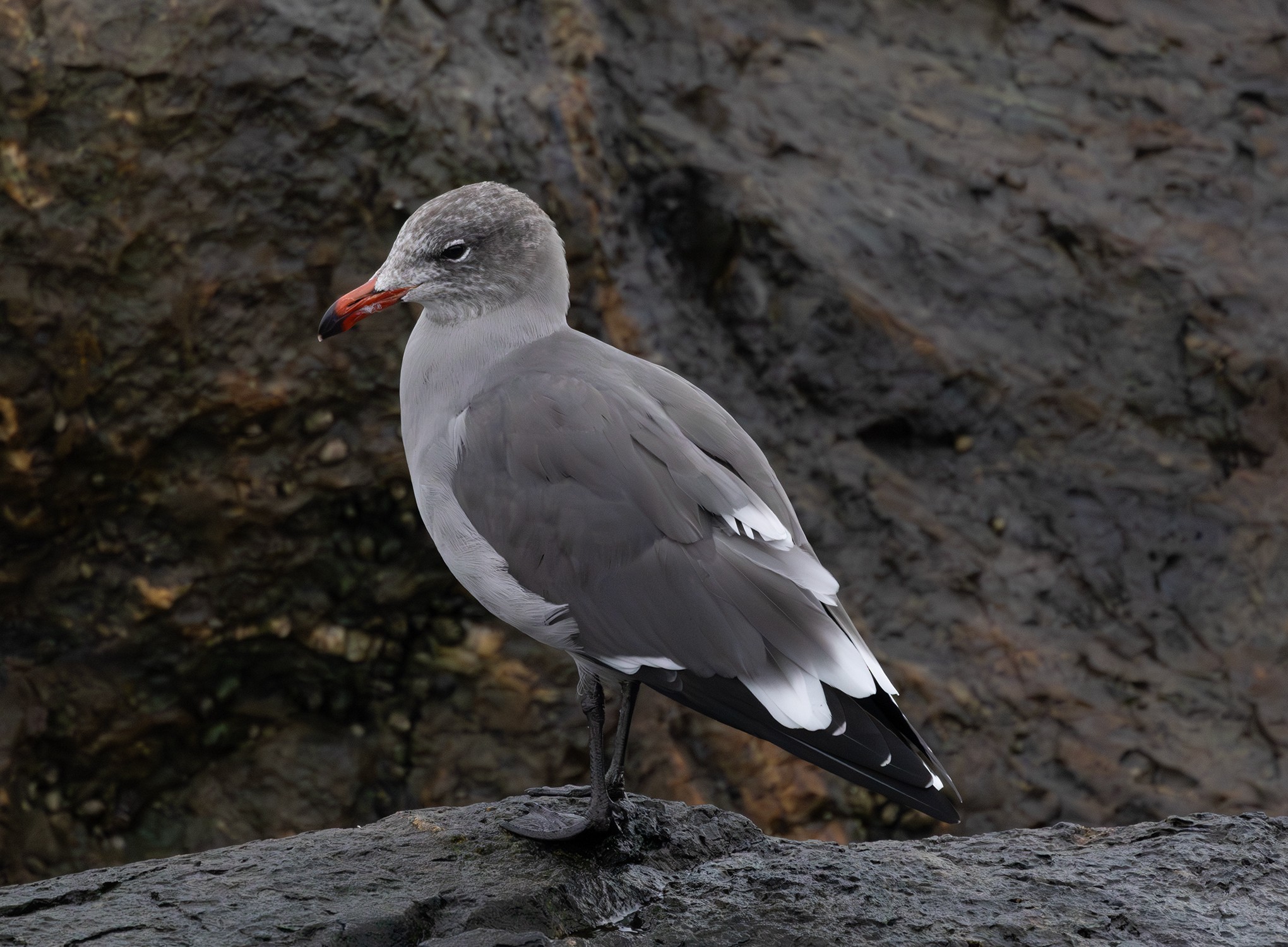
Heermann’s Gull
1. White-headed Gull
Other than perhaps Grey Gull, no other gull species has a contrasting white head and dark body.
2. Isla Rasa Gull
Although beginning to nest on rooftop colonies in Mexico and southern California, the vast majority of the global breeding population nests on this one island.
Saunder’s Gull
Chinese Black-headed Gull (Avibase)
Seems straightforward enough. Perhaps a potential name could reflect this gull’s reliance on tidal habitats.
Hartlaub’s Gull
1. South African Gull
Naming this species after its limited range (coastal Namibia and western South Africa) helps to distinguish it from the similar Grey-hooded Gull.
2. King Gull (Avibase)
Pallas’s Gull
Great Black-headed Gull (Avibase)
Almost as large as a Great Black-backed Gull, no other hooded gull comes close in size (Olsen 2018).
Audouin’s Gull
Fish Gull
This uncommon gull specializes more in fish compared to other species in its range. Think Fish Crow, but a gull!
Belcher’s Gull
1. Humboldt Gull
Like Humboldt Penguin, this name reflects this species’ distribution in the Humboldt Current area of South America.
2. Band-tailed Gull
This was its name before being split from Olrog’s Gull.
Olrog’s Gull
Crab Gull
A crab specialist vulnerable to habitat loss (Yorio 2024). Similar reasoning to Fish Gull.
*If you tell someone to be on the lookout for a Black-throated Yellow Warbler, the name conjures up a far more useful picture than Townsend's Warbler. John Kirk Townsend had literal skeletons in his closet, which he dug up from indigenous graves to prove the superiority/inferiority of certain races. As the binomial Setophaga townsendi is controlled by the International Code of Zoological Nomenclature, I would not feel heartbroken for those who criticize the English name change on historical grounds.
Citations
- Adriaens, Peter, Mars Muusse, Philippe J. Dubois, Frédéric Jiquet. “Gulls of Europe, North Africa, and the Middle East.” Princeton University Press, 2022, p. 6.
- Day, R. H., I. J. Stenhouse, H. G. Gilchrist. “Sabine’s Gull.” Birds of the World. Cornell Lab of Ornithology, 4 Mar. 2020, https://birdsoftheworld.org/bow/species/sabgul/cur/introduction. Accessed 26 May. 2026.
- Ayyash, Amar. “The Guide Guide: North America.” Princeton University Press, 2024, p. 92.
- Olsen, Klaus Malling. “Gulls of the World: A Photographic Guide.” Princeton University Press, 2018, p. 46.
- Yorio, Pablo “Olrog’s Gull.” Birds of the World. Cornell Lab of Ornithology, 3 May. 2024, https://birdsoftheworld.org/bow/species/olrgul1/cur/introduction. Accessed 26 May. 2026.