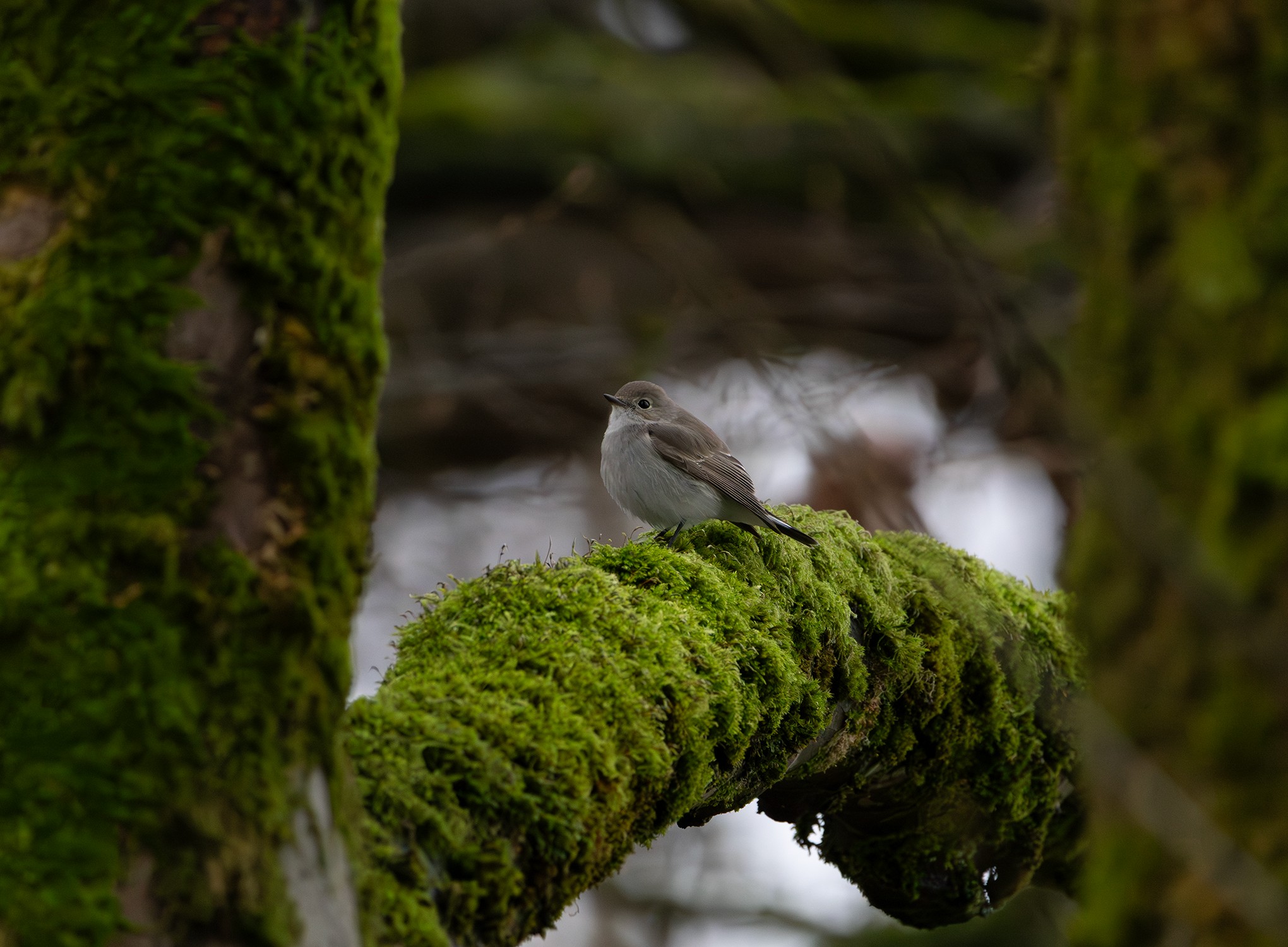
A Christmas Miracle
It was Christmas Day, and I was itching to get outside. After spending the morning with family, I checked my weather app. A clearing in the rain gave me enough time to get out for a quick bird outing. On a whim, I decided to walk the seawall along Sunset Beach Park, which is only a short stroll from home. During the winter months, and when the tide is high enough to deter people and dogs from clambering around the exposed seaside, wintering Short-billed Gulls loiter on a patch of rocks near the Inukshuk Monument, a smorgasbord of white and grey and coffee-with-cream-brown. One time, a Bonaparte’s Gull joined the congregation, a species that I am used to seeing either bobbing up and down in the bay, or slicing through the air with ivory-edged wings.
Slowly, I made my way out of False Creek, my senses perhaps heightened by a world subdued. Traffic seemed quieter than normal, and heavy skies blanketed the landscape in a dull light.
I had tempered my expectations for what I might find. A Long-tailed Duck or Surf Scoter diving near the seawall. Some Ring-billed Gulls scouring the grass for any potential morsel. Perhaps an overwintering warbler’s song emanating from one of the few trees planted around the park.
By the time I reached the aforementioned Short-billed Gull grouping at the farthest end of the park, I was already content with what I had seen: Bonaparte’s Gulls flying circuits in and out of False Creek, occasionally diving down for fish; a battalion of Barrow’s Goldeneyes making their way from underneath Burrard Bridge; and watermelon-shaped Cackling Geese grazing below the hornbeams.
Satisfied with what I had seen, I began walking home at a brisk pace on the sidewalk adjacent to Beach Ave. As I approached Bute St, a small bird darted into my periphery. Its behaviour is what caught my eye, sallying from low-hanging branches to the ground and bases of trees, behaviour exhibited only by the occasional Yellow-rumped Warbler wintering in the area. My interest piqued, I pull up my camera in its sling, attempting to get identifiable shots as the bird flitted from mossy branches to leaf-littered ground.
Mentally, I started flipping through my avian bestiary in search of any local species that might fit this bird’s description: white eye ring; Greyish brown upperparts; whitish throat; and pale underparts.
As embarrassed as I am to admit this, the closest candidate I came to in those first moments was an aberrant, runty Townsend’s Solitaire, based mainly on the eye ring and overall colouration, and even then, something was not sitting right with me. (I would see my first TOSO a month later. They are similar in size to American Robin, larger than the bird I encountered that previous December.)
To get secondary opinions, I sent photos to a few friends and Melissa Hafting, the local eBird reviewer who also runs the British Columbia Rare Bird Alert. Once the excited replies started coming back, I quickly realized why I could not assign this bird to anything I recognized*. This bird, a Taiga Flycatcher, should be on the other side of the Pacific!
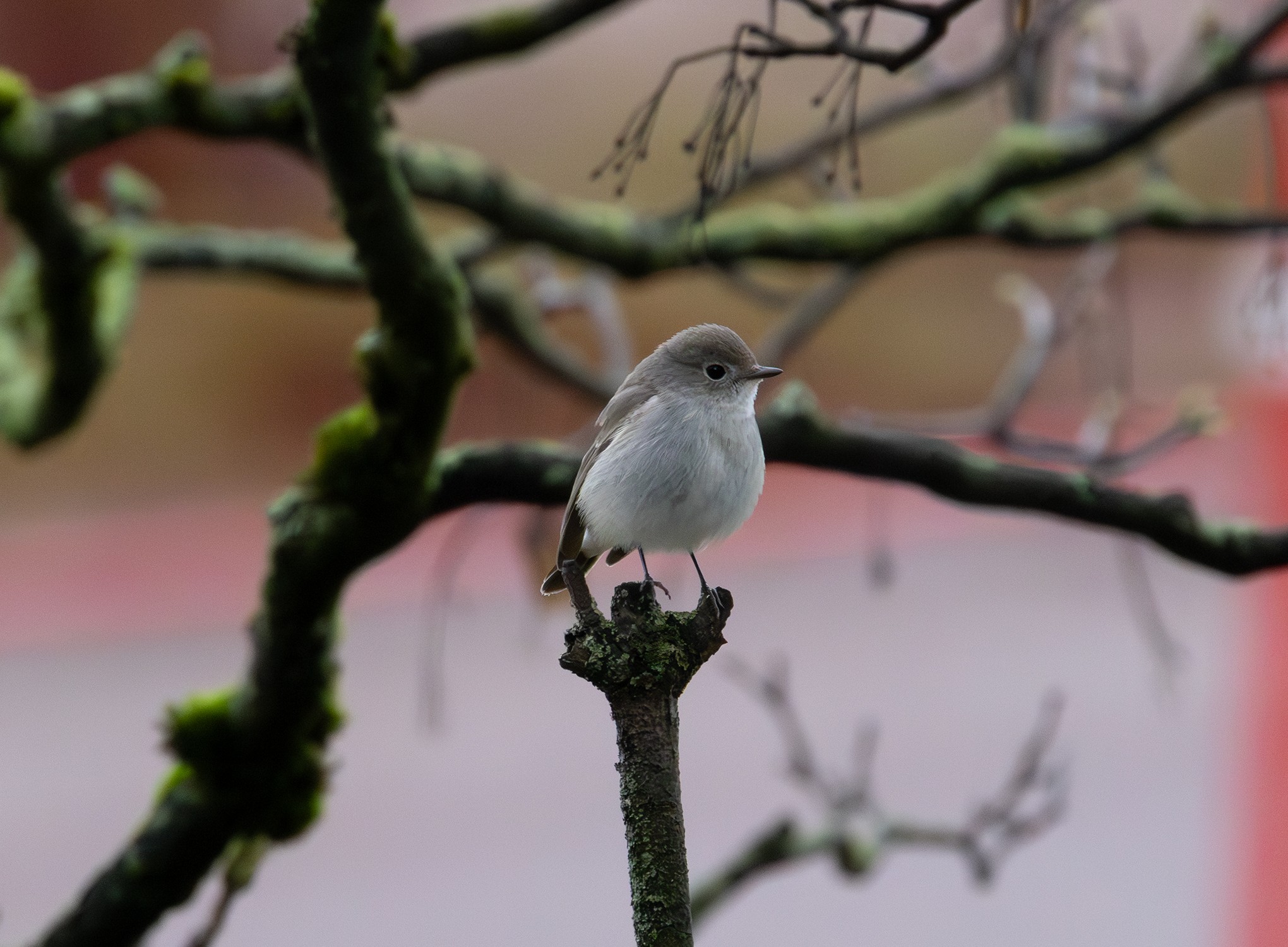
The Taiga Flycatcher is a member of the family Muscicapidae, the Old World flycatchers, and is more closely related to the thrushes (Turdidae) than any flycatcher species in North America. In 2005, Taiga Flycatcher and the similar Red-breasted Flycatcher (Ficedula parva) were split into separate species (Svensson et al. 2005).
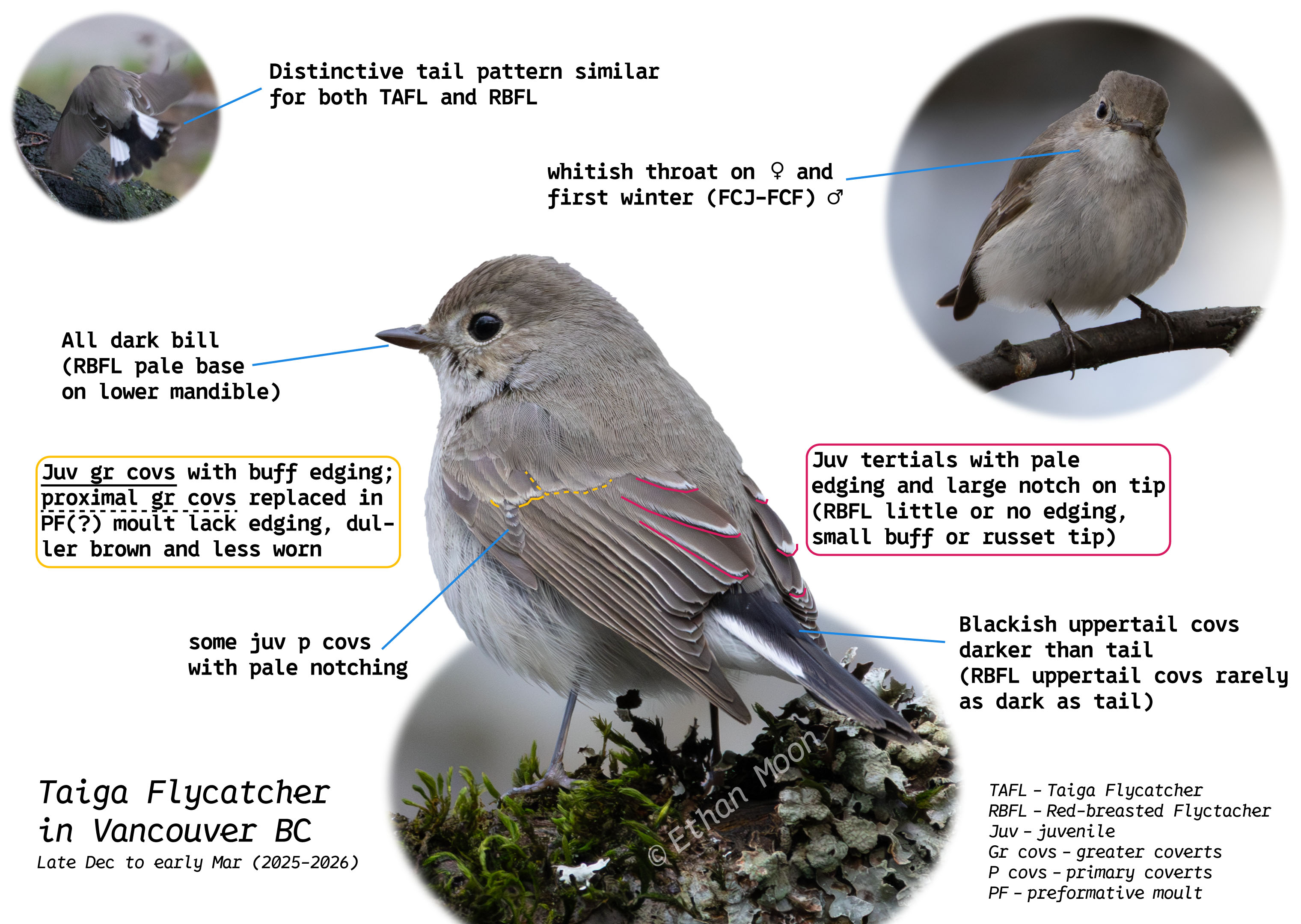
Field marks that are diagnostic for both sexes of Taiga Flycatcher include:
- Black uppertail coverts that are darker than the central rectrices (tail feathers); Red-breasted Flycatchers’s uppertail coverts are paler or just as black as the central rectrices (Duivendijk 2024).
- An all-black bill; Red-breasted usually has a pale base to the lower mandible.
- Tertials of immature birds have a large notch and pale buff edging on the outer web; Red-breasted tertials have a smaller wedge-shaped tip that is russet or buff, and there is little or no distinct edging (Cederroth et al. 1999).
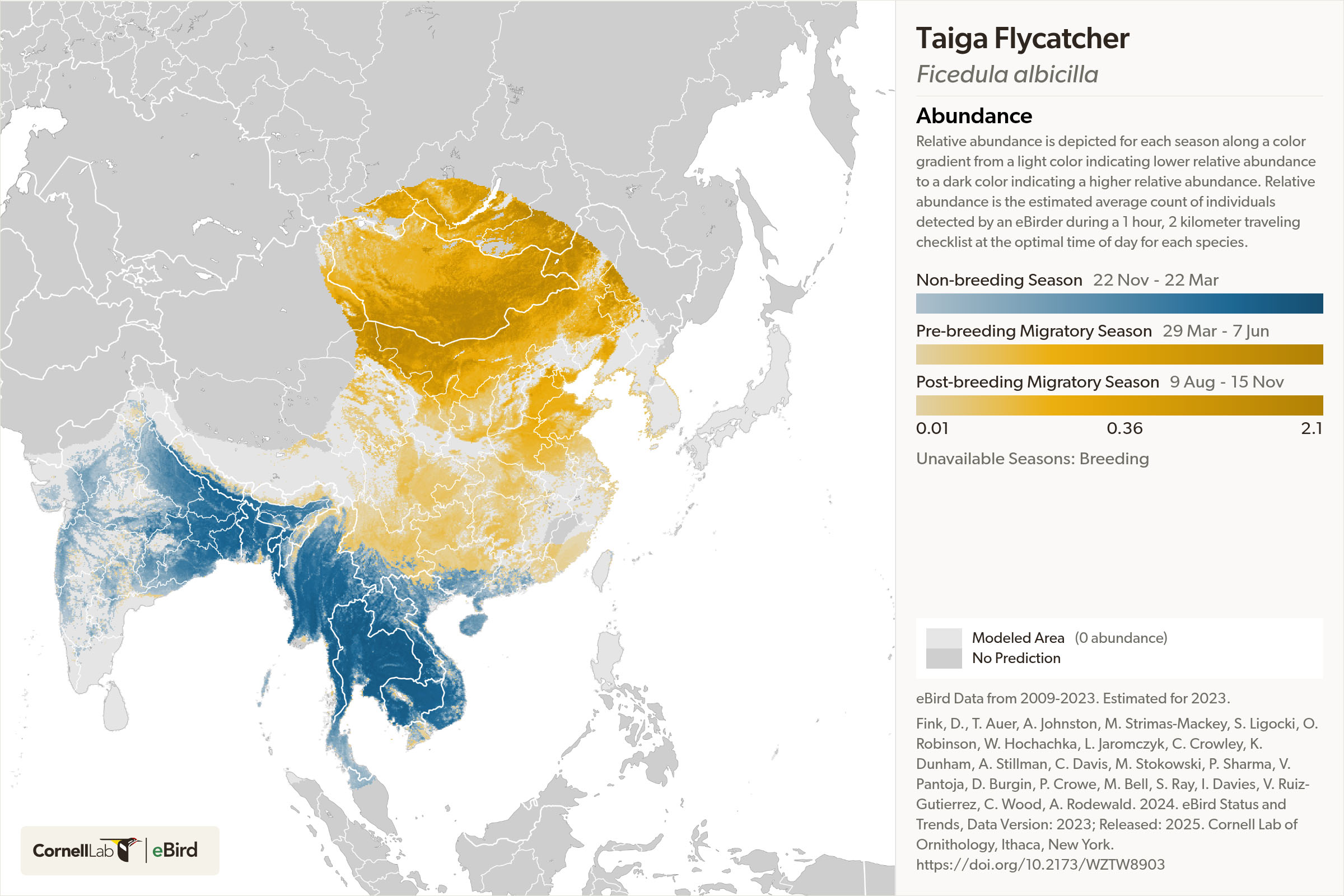
The Taiga Flycatcher breeds in the taiga (or boreal) forests of Russia, from the Urals to Yakutia and southern Chukotka, south to the Kamchatka Peninsula (Brazil 2009). It is a migratory species, wintering in India to northern Southeast Asia and southern China.
There are multiple records of Taiga Flycatcher in western Alaska and the Aleutians. However, up to Christmas 2025, there was only one record of this species in mainland North America, in Yolo/Solano county California in late October 2006 (Swick 2018).
Once the word started getting out, a small number of local birders began arriving in the waning daylight hours, rain finally beginning to pour down. It was not until the next morning however, when I approached over 60 birders standing on the seawall near the Vancouver Aquatic Centre, binoculars and cameras trained on this humble bird as it foraged in a small patch of understory, that the significance of my discovery started to sink in. Acquaintances and Strangers congratulated me on being the first to see this species in Canada, which, up until yesterday, I had not even known existed. (In early February of the following year, Matt Brady found the first Taiga Flycatcher in Mexico, making it the third record for mainland North America. What a strange season!)
Melissa started connecting me with different news outlets to help get the public excited about this rare find. Over the next few weeks, I was out giving interviews and having conversations with people from disparate places like Alberta, Washington, Alaska, Florida, North Carolina, Ontario and New York.
One day, while observing the TAFL (the 4-character code used for Taiga Flycatcher) hop from branch to ground in search of invertebrates to eat, I met Christian Cederroth, who was the first to report Taiga Flycatcher in Sweden (Cederroth et al. 1999). Few people have studied the moult of this bird in detail. Christian said he was the first to describe the postbreeding moult of the Taiga Flycatcher, which, unlike its relative the Red-Breasted Flycatcher, reduces the characteristic reddish-orange throat patch in males during the winter.
Unfortunately, Christian’s paper from 1999 is not accessible online, and in-depth information on the moulting regiment of the Taiga Flycatcher is lacking, at least digitally. However, with the help of field guides and pictures from Macaulay Library, as well as papers describing moult and plumage in related flycatcher species, we can attempt to answer two important questions: How old is this bird? And what sex is it?
(Note: I am about to get into the weeds and talk about moult. If that does not interest you, you can skip to the next section. I recommend watching one of Peter Pyle’s talks for a thorough introduction to this subject. Vancouver Avian Research Centre also has a webpage chock-full of charts to help familiarize yourself with moult and aging of birds.)
Moult in Relation to the Taiga Flycatcher
Moult is a process of renewal that replaces worn feathers or parts of a plumage during different life stages (Jenni, Winkler “The Biology of Moult in Birds” 2020). All birds replace most or all of their feathers at least once per year. Although the physiological mechanisms involved in this process are complex, moult of certain sections, or tracts, of feathers, particularly wing and tail feathers, occurs in predictable sequences.
For example, the European Pied Flycatcher, which is in the same genus Ficedula as Taiga Flycatcher, usually replaces its entire plumage once per year in the prebasic (postbreeding) moult, although a small number of individuals in migratory populations retain inner secondaries (Jenni, Winkler “Moult and Ageing of European Passerines” 2020). Like in most birds, primaries (flight feathers attached to the hand) are always replaced one after another in the direction away from the body (distally), while most secondaries (flight feathers attached to the ulna or forearm) are replaced towards the body (proximally). These moult sequences are never played in reverse and, unless suspended due to trauma or food stress, reoccur cyclically at similar times each year.
The repetitive and predictable nature of moult cycles in birds allows researchers and birders alike to age and sex many birds in the field, including our Taiga Flycatcher.
I will try to demonstrate.
A couple of weeks after the first sighting of the Taiga Flycatcher, and eight eBird checklists later, I was looking at photos I took moments earlier, settling on an image of a closed wing:
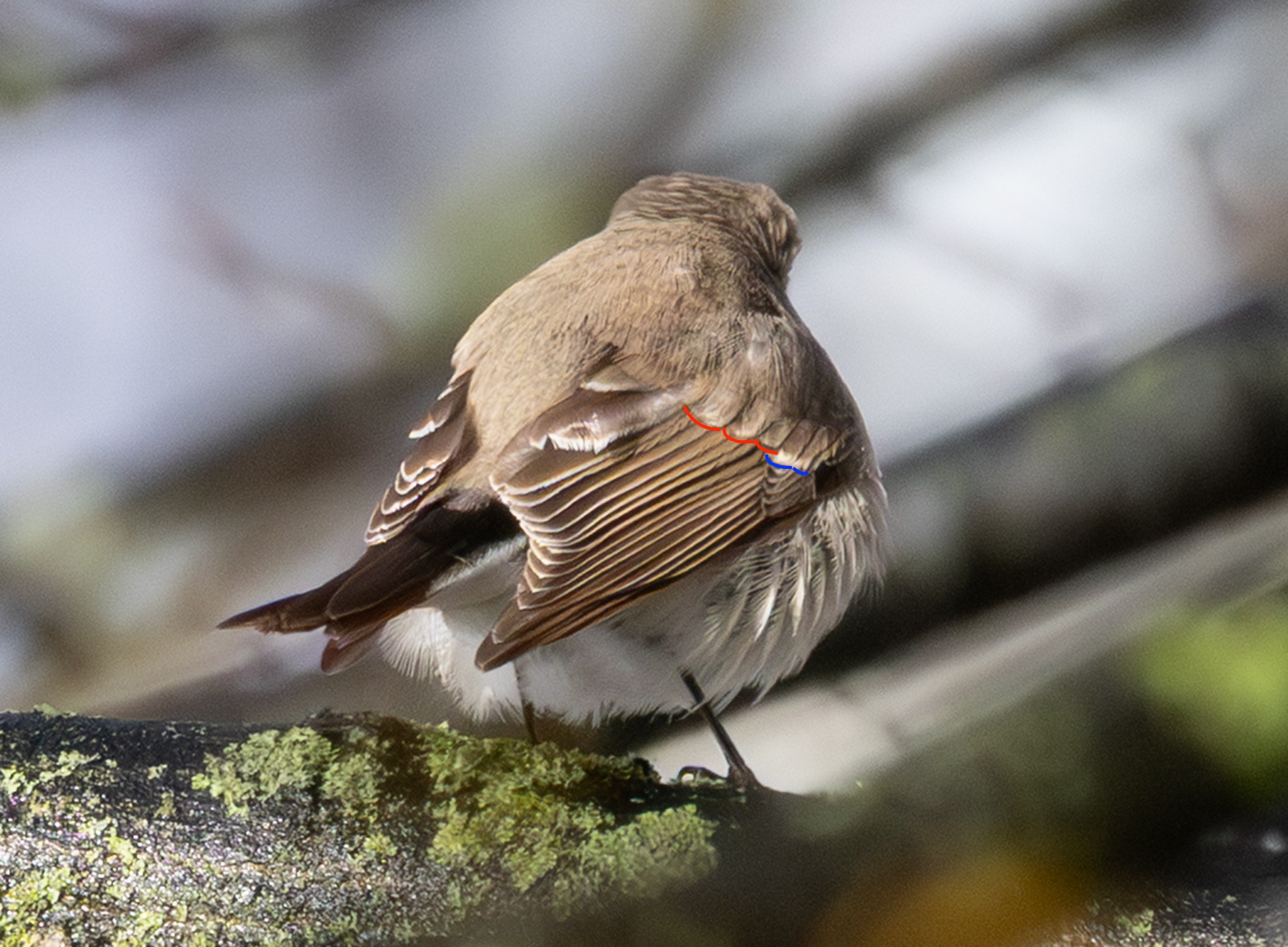
Unlike the outermost greater coverts (GCs), the inner GCs lack white edging and are a greyer shade of brown. This is indicative of a moult limit: The boundary between old and replaced feathers.
Juvenile Taiga Flycatchers have pale tips to their tertials and greater coverts (Duivendijk 2024). The juvenile plumage is grown as fast as possible to facilitate leaving the nest, the tradeoff being that those feathers are of poor quality, and are more prone to wear than subsequent feather generations. Many passerines have evolved an inserted moult (or moults) in their first cycle to stave off deterioration until the next complete (prebasic/postbreeding) moult. European Pied Flycatcher can also be aged in the first and second calendar year by moult limits in the GCs (Jenni, Winkler “Moult and Ageing of European Passerines” 2020).
Even without seeing the moult limit between juvenile and replaced (presumed formative) feathers, we can confidently say that this individual was hatched last year (Second Year [SY]/First Cycle [FCF-FPA]) based on the fringing to the tertials and remaining GCs.
Identifying the sex of young Taiga Flycatchers is tricky, since both males and females look similar until the prealternate (prebreeding) moult commences in spring, when males develop a reddish-orange throat patch. My light perusal of images on Macaulay Library seems to suggest that most SY males develop at least a portion of their throat patch in February through March, suggesting that our bird is female. However, because some researchers recommend leaving second year Red-breasted Flycatchers unsexed into May, I prefer to err on the side of caution (Hellström 2014).
Winter Neighbours
eBird says I submitted 26 observations of the Taiga Flycatcher between December 26 2025 and March 2 2026. This is an undercount. There were multiple occasions when I would walk past Sunset Beach Park, whether for birding or running errands, and I would catch a glimpse of that mega rarity going about its day.
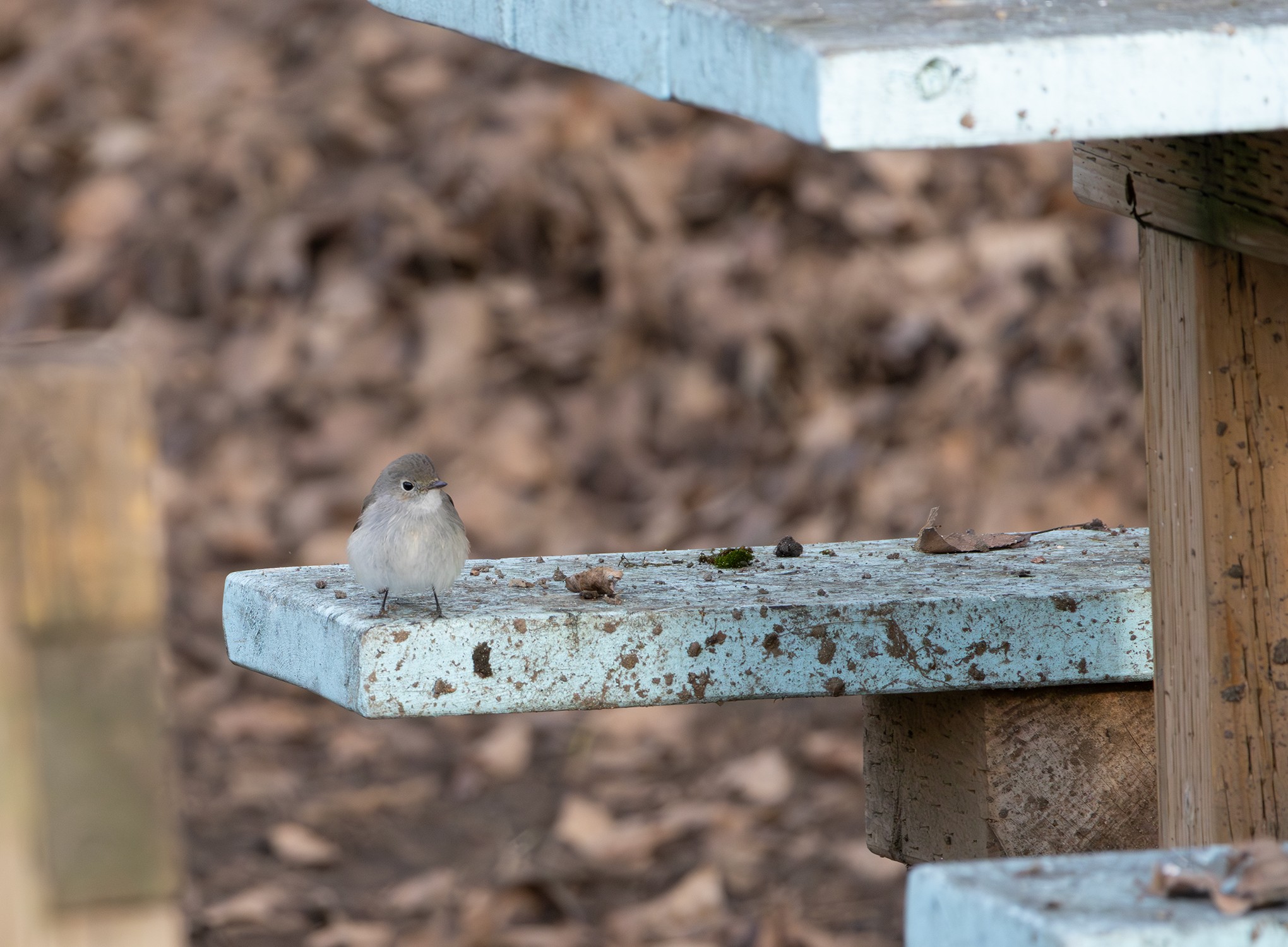
This bird became a normal part of my life. A sense of familiarity developed via proximity. Every day, I could walk down to the park and expect to see the same familiar actors: House Finches and House Sparrows chirping and clambering about a patch of shrubbery on the corner of Thurlow St and Beach Ave; a flock of mallards, either at the beach, or waddling up to some locals who have been providing handouts (to my chagrin); Pelagic Cormorants flying in and out of False Creek; Crows and Gulls up to their usual antics; and one singular Taiga Flycatcher, either resting high up in a tree or charging at any critter that moves.
It had remarkable site fidelity, being observed only between the Aquatic Centre and Jervis Street. Most of the time, it stayed on the park side of Beach Ave, taking a route through the Hornbeams that line the road. On occasion, it would fly over to trees on the other side of Beach Ave. Some of my best pictures are from when it would forage in the front area of an apartment building, hunting for flies in characteristic flycatcher fashion. (People would come up to me and express their worries about whether or not the Taiga Flycatcher was finding enough food. I have seen this bird catch flies, larvae, caterpillars, worms and earwigs. Whatever threats might have faced this bird, starvation was not one of them.)
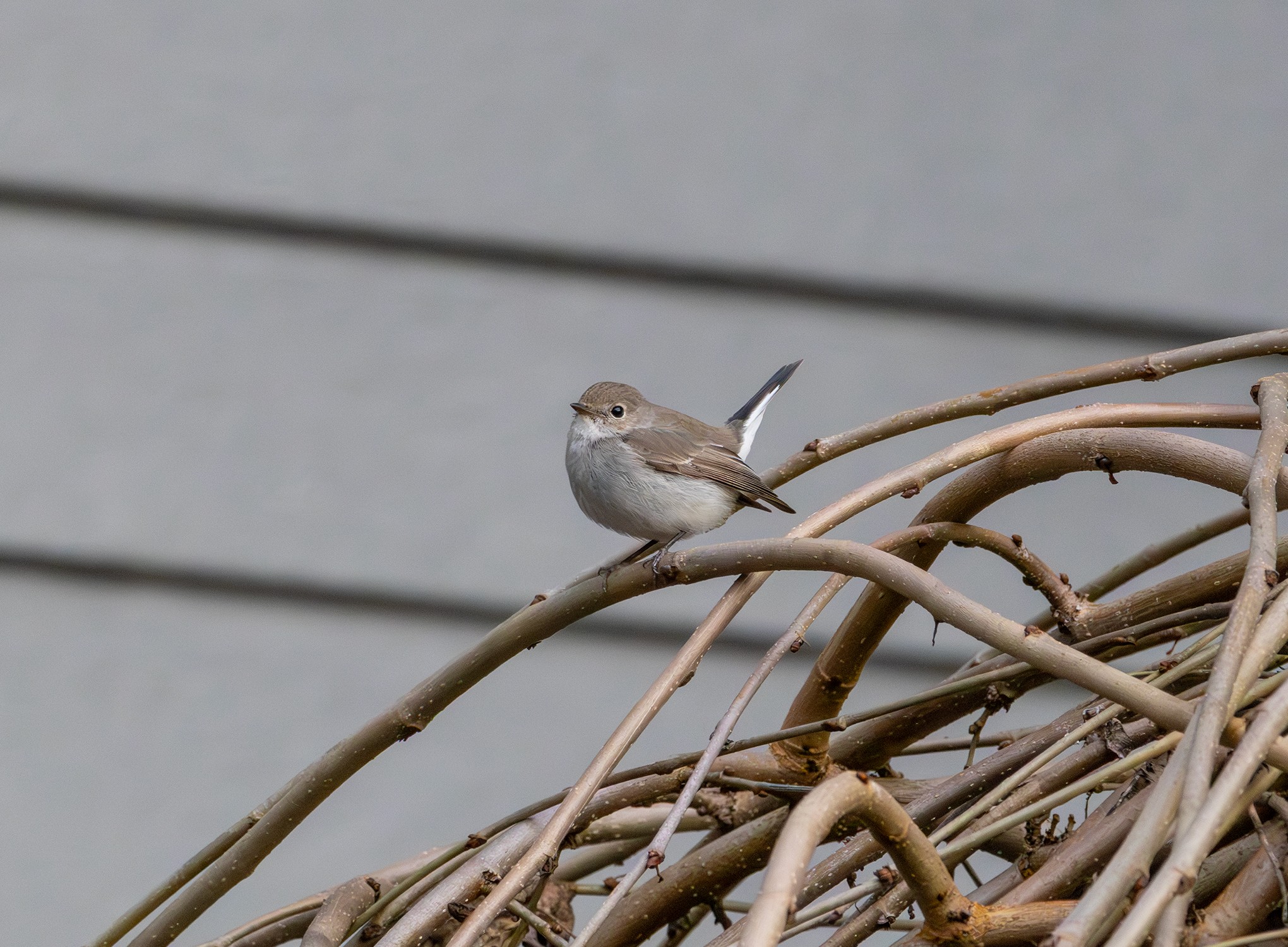
I kept reminding myself to not take this for granted. Migratory restlessness is instinctual. With increasing daylight and rising temperatures, the Taiga Flycatcher would develop the urge to fly north to its breeding grounds.
There is no way of knowing whether or not it gets stuck in Alaska or is able to cross back to Russia. Perhaps by some miracle it comes back to winter in the same park on the wrong side of the ocean. One can dream.
During this time, I got to network with many interesting people. It is amazing how one bird in an urban park can draw so many people together. Like the Taiga Flycatcher, after a long journey across an ocean and continents, hundreds of photographers, birders and nature lovers from all over have found reason to gather on this small patch of land–a refugium of common interest.
March 2 was the last time I saw the Taiga Flycatcher (Hafting 2025). One of the heavy hitters in the local bird scene spotted it briefly near Jervis St, so I came down to get a look–I wanted the TAFL on my monthly bird list.
And so, like many days before and since, I waited, planting myself below a mossy tree that abuts the sidewalk. The flycatcher, becoming more reticent as the weeks wore on, was spending more time at the tops trees instead of foraging near the ground, perhaps due to higher numbers of flying insects as winter waned.
I stood under that tree for around half and hour, eyes darting to any sign of movement. Two Dark-eyed Juncos busily searching carpeted branches. Silhouettes of flying Olympic/Glaucous-winged Gulls passing behind the treetops. A swarm of Bushtits dozens strong zooms by like an army of locusts in search of farmland to decimate. A Black-capped Chickadee appears among the highest reaches of the tree.
That is when I see it. For precious seconds, the Taiga Flycatcher perches on a branch stub, fanning its bicoloured tail, then darts off to the right. I tried to locate it among the chickadees and juncos, but came up short.
And just like that, I would never see it again.
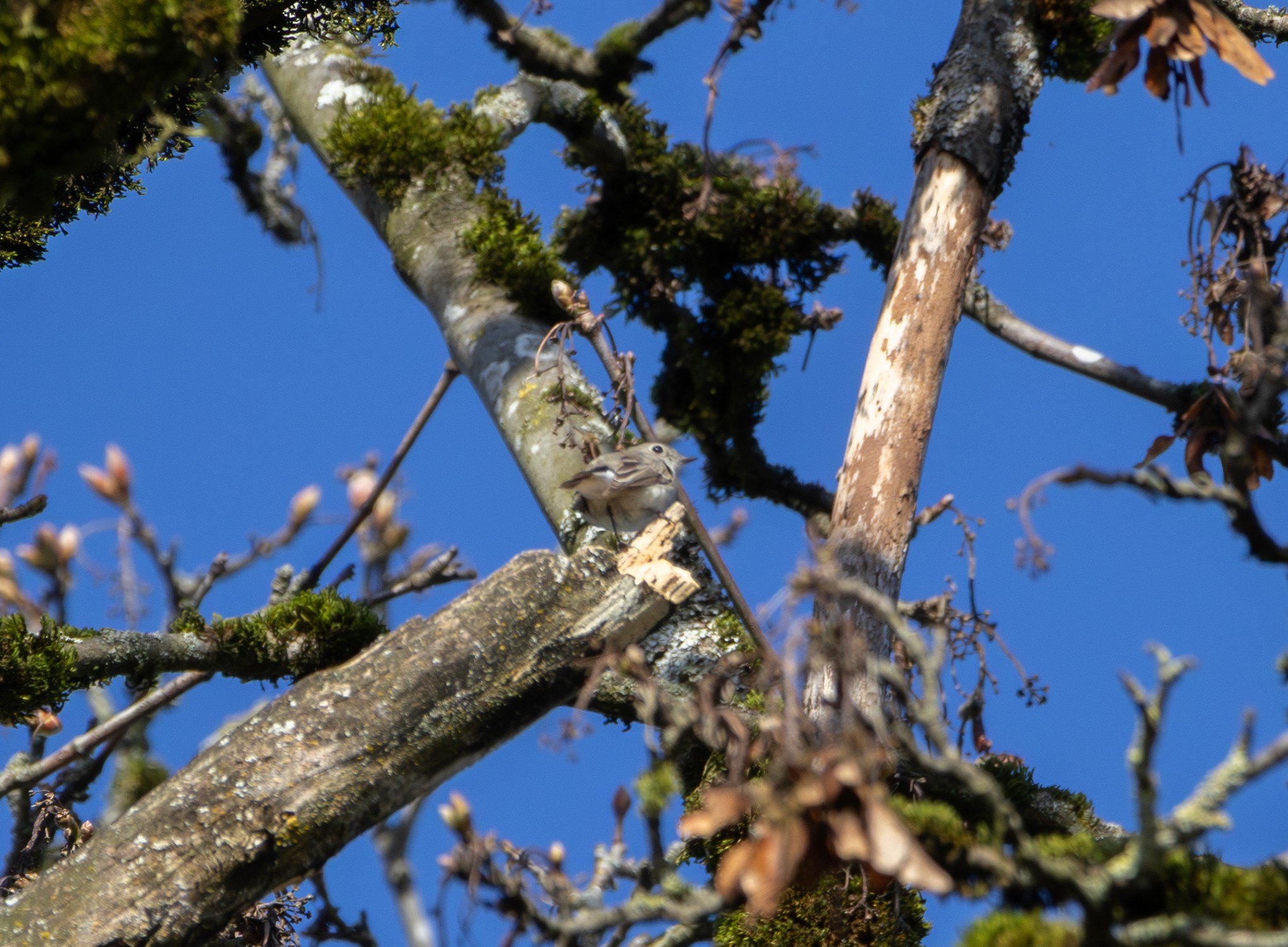
I had read that Taiga Flycatchers begin migrating to their breeding grounds in April, so I was hoping for at least a couple more weeks with this bird (Hoyo et al. 2020).
Despite multiple attempts over the subsequent week, I could not relocate it. The last confirmed sighting is on March 8 2026. It is plausible that the TAFL was evading detection–there were nowhere near the number of observers then compared to January and early February. Perhaps the TAFL found better provisions elsewhere. Or maybe the local Cooper’s Hawk finally caught up with it. (Do immature Taiga Flycatchers migrate early to compete for breeding territory?)
With all that said, early March is still within the migratory window, so I am inclined to believe that the TAFL had begun its trip home.
In any case, I am tremendously grateful for this experience, and I hope at least a few people–whether they were walking past the park and asked what the paparazzi were looking at, or read one of the dozen or so articles about this sighting–found room for birds in their own lives.
Location bias is the only reason people traveled from all over to see a drab bird in Southern British Columbia. We easily take for granted the creatures and ecosystems we share. Even a piss-stained park, soil compacted from countless footsteps and picnics, supports a diverse collection of organisms, each with their own stories to tell.
Imagine what else would turn up in our neighbourhoods if we allowed some nature back in: Planted native shrubs–not just trees!–in our parks, like Nootka rose and Salmonberry; did everything we could to make sure our pets and introduced species were not predating on wildlife*; reduced window collisions with solutions already on the market.
Like small acts of kindness, every step we make as a community towards sustainability allows future generations to experience the joy of the natural world for the first time. The tiny wonders that imbue colour and discovery into an otherwise turbulent world.
Thank you Taiga Flycatcher for spending the winter in my neighbourhood. For bringing so much joy to so many lives.
Wherever you may be, godspeed.
*Feral and free-ranging domestic cats kill billions of birds and mammals each year, making them one of the greatest sources of wildlife fatality caused by humans (Loss et al. 2013). There are plenty of websites that provide advice on how to reduce your cat's impact on local wildlife.
Learn More About the Taiga Flycatcher
- https://bcrarebirdrecords.ca/species/taiga-flycatcher
- https://daretobird.blogspot.com/2025/12/first-canadian-record-of-taiga.html
- https://birdsoftheworld.org/bow/species/taifly1/cur/introduction
Some of My Interviews
- https://globalnews.ca/news/11592512/rare-bird-vancouver-taiga-flycatcher/
- https://www.thecanadianpressnews.ca/rare-taiga-flycatcher-sighted-in-vancouver/video_b29223e7-6073-5a21-9955-22092d503d4e.html
- https://www.ctvnews.ca/vancouver/article/crowds-gather-in-vancouver-park-to-photograph-bird-never-before-seen-in-canada/
- https://vancouver.citynews.ca/2025/12/29/first-sighting-of-rare-bird-in-vancouver/
- https://vancouversun.com/news/local-news/heres-why-bird-watchers-have-been-flocking-to-vancouvers-west-end
- https://www.cbc.ca/listen/live-radio/1-46-on-the-coast/clip/16189675-taiga-flycatcher-spotted-canada-ocean-away-its-natural
Videos
Citations
- Svensson, Lars, Martin Collinson, Alan G. Knox, David T. Parkin, George Sangster. “Species limits in the Red-breasted Flycatcher.” Vol. 98, British Birds, Oct. 2005.
- Duivendijk, van Nils. “ID Handbook of European Birds.” Vol. 2, Princeton University Press, 2024, p. 889.
- Cederroth, Christian, Cecilia Johansson, Lars Svensson. “Taiga Flycatcher Ficedula albicilla in Sweden: the first record in Western Europe.” Vol. 12, Birding World, 1999, pp. 460-469.
- Brazil, Mark. “Birds of East Asia.” Helm Field Guides. Christopher Helm London, 2009, p. 438.
- Swick, Nate. “#ABArare – Willow Warbler, Taiga Flycatcher – Alaska.” American Birding Association, 5 Sep. 2018, https://blog.aba.org/2018/09/abarare-willow-warbler-taiga-flycatcher-alaska.html. Accessed 2 Apr. 2026.
- Jenni, Lukas, Raffael Winkler. “The Biology of Moult in Birds.” Bloomsbury Publishing, 2020, pp. 58-59.
- Hellström , Magnus. “Ficedula parva - sexing spring.” Ringer’s DigiGuide, Sep. 2014, https://ringersdigiguide.ottenby.se/species/ficedula-parva/sexing-spring/. Accessed 2 Apr. 2026.
- Hafting, Melissa. “RBA: TAIGA FLYCATCHER in Vancouver - Dec 25/25-March 8/26.” British Columbia Rare Bird Alert, 25 Dec. 2025, https://bcbirdalert.blogspot.com/2025/12/rba-taiga-flycatcher-in-vancouver-dec.html. Accessed 2 Apr. 2026.
- Hoyo, Josep del, Nigel Collar, Guy M. Kirwan, David Christie. “Taiga Flycatcher.” Birds of the World. Cornell Lab of Ornithology, 4 Mar. 2020, https://birdsoftheworld.org/bow/species/taifly1/cur/introduction. Accessed 2 Apr. 2026
- Loss, Scott R., Tom Will, Peter P. Marra. “The impact of free-ranging domestic cats on wildlife of the United States.” Vol. 4, Nature Communications, 2013, https://www.nature.com/articles/ncomms2380.